
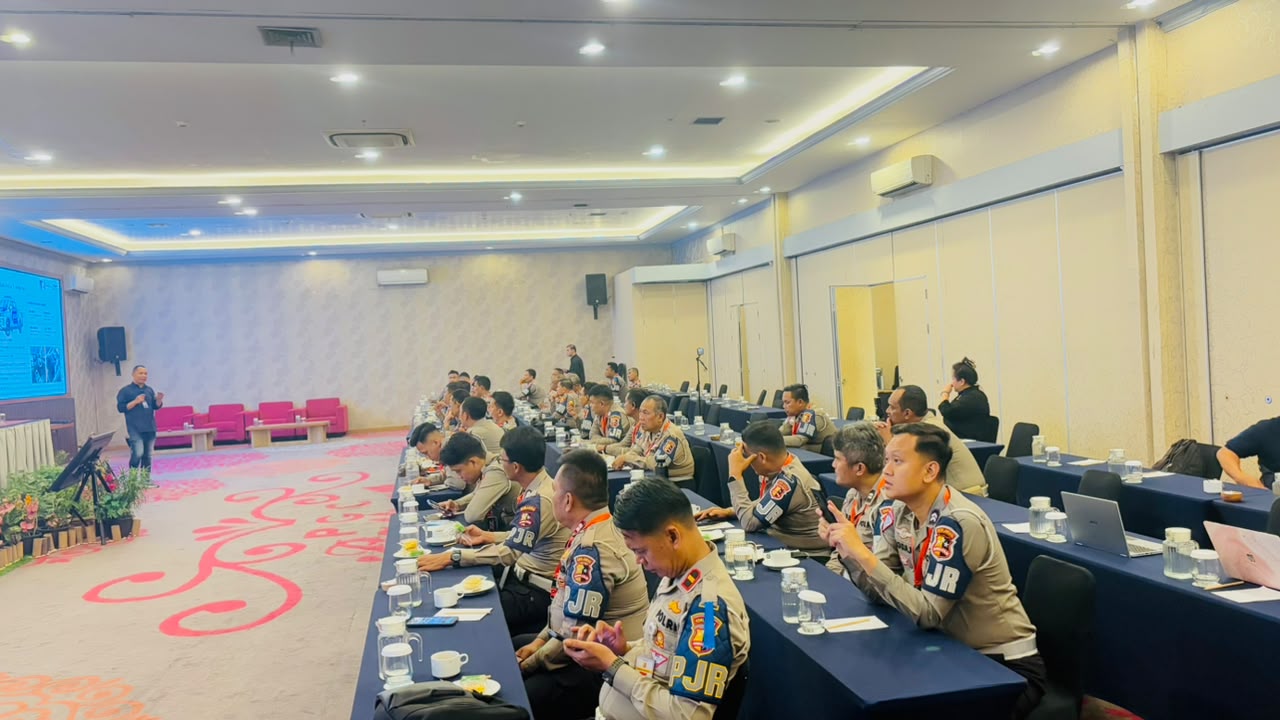
JAKARTA — The Indonesian National Police (Polri) continues to enhance the capacity and skills of its personnel in operating eco-friendly future fleets. This concrete step is evident in the ongoing Technical Training (Latnis) on 4×4 Double Cabin (DC) Patrol Vehicles Utilizing Electric-Hybrid and Battery-Powered Technology. Entering its second day, the educational program organized by Korlantas Polri took place at Fave Hotel PGC Cililitan, Jakarta, on Wednesday (10/28/2026).
Entering the second day of training material, Nana, an instructor from GWM, focused the session on basic operational procedures and the vital maintenance of electrical components. Participants began the training by learning precise steps to power up these hybrid vehicles.
Beyond driving techniques, this indoor educational session strongly emphasized the importance of battery lifespan management for police vehicles. The instructor provided specific guidance instructing officers to avoid charging the battery to maximum capacity too frequently in order to maintain long-term power durability.
“Therefore, do not charge to 100 percent too often. Because at full charge, the temperature is higher, and second, cell health is significantly affected,” Nana explained to the participants.
Energy Charging Mechanisms and Safety Features
The discussion then shifted to energy charging mechanisms and vehicle safety layers. The instructor outlined the clear differences between using Alternating Current (AC) charging sockets for slow charging and Direct Current (DC) sockets for super-fast charging.
Furthermore, the liquid cooling system (water cooling) was highlighted as a critical automotive safety mitigation feature to prevent overheating risks.
“If the battery gets too hot with high temperatures, it can lead to a fire. That is why the cooling system in electric vehicles is extremely critical. If it fails to work properly, the system automatically cuts off the current as a safety feature,” the instructor emphasized in front of the officers.
Troubleshooting and System Anomaly Simulations
Toward the end of the session, participant enthusiasm was evident during the Q&A segment. One officer inquired about the safe minimum battery level and solutions if a vehicle experiences a complete shutdown with the battery fully drained during charging.
In response, the instructor explained that while there is no absolute minimum threshold, keeping the battery level at a minimum of 70 percent is highly recommended. As for total vehicle shutdown anomalies, such issues are generally triggered by disruptions in the high-voltage battery system or malfunctions in the charging system, which must be thoroughly diagnosed using a specialized diagnostic scanner.
Throughout the training, all participants received strict operational instructions regarding patrol vehicles such as the Geely Ridara RD6 4WD, GWM Cannon PHEV 4WD, and Tank 300 PHEV. This comprehensive technical skill preparation is expected to maximize Korlantas Polri’s adaptive and professional public services.
Visit us for more information regarding IT specialist solutions and ongoing technology system updates on the official PT Qudo Buana Nawakara website at qudo.id.