
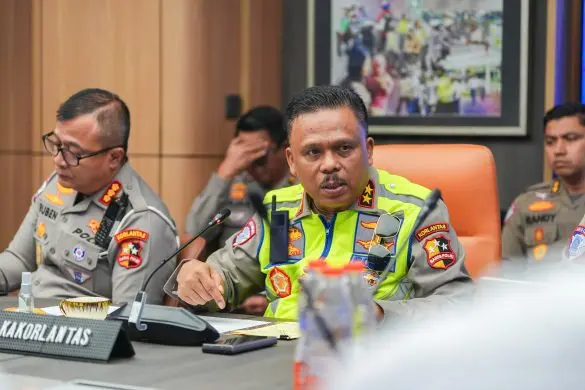
JAKARTA — The Traffic Corps (Korlantas) of the Indonesian National Police is paying full institutional attention to the consistently high rate of traffic accidents occurring across Indonesian public roads. Based on in-depth analysis and evaluations conducted by the Korlantas team, the operation of Over Dimension and Over Loading (ODOL) vehicles is heavily blamed as one of the primary triggers of fatal road accidents.
Head of Korlantas Polri, Irjen Pol. Drs. Agus Suryonugroho, S.H., M.Hum., disclosed the national accident statistics for the 2024–2025 period. The data showcases a worrying trend regarding the overall quantity of incidents, though it offers a brief ray of hope due to a slight decline in the fatality rate of road victims.
Throughout the year 2025, the total number of traffic accidents across Indonesia climbed significantly, reaching 158,508 recorded incidents. This total volume marks a 5 percent surge when contrasted with the 2024 period, which documented 150,906 cases on public streets.
Despite the upward trajectory on the overall accident graph, Korlantas Polri successfully pushed down the number of fatalities by 9.5 percent. The total death count was successfully mitigated from 26,839 individuals in 2024 down to 24,296 lives by the close of 2025.
“The scale of traffic accidents to this day remains quite significant. One of the main contributing factors behind these incidents is the prevalence of over-dimension and over-loading vehicles, alongside transport configurations that are not environmentally friendly,” stated Irjen Pol. Agus Suryonugroho.
Prioritizing the Right to Life Over Financial Profits
The two-star general clearly explained that the complicated ODOL truck crisis cannot be classified merely as a common administrative traffic violation. The destructive impacts caused on open asphalt directly correlate with the loss of road users’ lives and the macro-level degradation of the national transport infrastructure system.
For this critical reason, the Korlantas team alongside related technical ministries and state agencies continue to accelerate the progressive implementation of the Zero ODOL policy. This mitigation strategy is actively pursued to slash macroeconomic accident risks and protect state budget spending on public highway repairs.
Irjen Agus firmly warned industrial players, fleet owners, and logistics entrepreneurs to stop turning a blind eye and sacrificing public safety considerations solely to secure short-term business profit margins.
“Public roads are shared living spaces. Therefore, every single decision to abide by safety regulations is a direct form of honoring the right to life of fellow commuters. There is no economic benefit that is far more valuable than human safety,” the Kakorlantas Polri remarked with solemn emphasis.
Commending the South Kalimantan Initiative as a National Pilot Project
During this periodic evaluation session, the Kakorlantas also expressed deep appreciation for the swift, proactive measures demonstrated by the South Kalimantan Regional Police and Lambung Mangkurat University (ULM). Both regional institutions effectively collaborated to launch a joint declaration committing toward an ODOL-free territory.
From his perspective, this progressive movement at the regional level serves as a crucial spark needed to ensure the success of the overarching national agenda. This framework is expected to inspire and be adopted by other regional police jurisdictions across the country.
Irjen Agus analyzed that the structural chain of ODOL truck violations will never be permanently severed if law enforcement agencies rely solely on manual field tickets or routine street crackdowns. This root problem must be systematically dismantled from a holistic standpoint, focusing on three deeply interconnected core pillars.
The first is the economic and fiscal pillar, which demands a comprehensive review of industrial incentive structures and freight cost formulations to keep logistics competitive yet legally healthy. The second is the sociological pillar, focusing on embedding a strong culture of legal compliance and growing an organic awareness for safe driving habits within the general public.
The third pillar revolves around regulation and enforcement synergy, which is executed by tightening supervision standards across weigh stations and applying strict, non-discriminatory legal sanctions directly on highway lanes.
Before the Zero ODOL framework goes live at full capacity nationwide, Korlantas Polri guarantees it will consistently engage various external stakeholders. This collaborative framework is aimed at scaling up massive educational campaigns to foster genuine, bottom-up public safety awareness.
The solid collaborative movement in South Kalimantan is highly expected to transform into a highly successful pilot project. This strategic blueprint is targeted to be mirrored and adapted smoothly by other Indonesian provinces to build a highly civilized and safe transportation environment.