
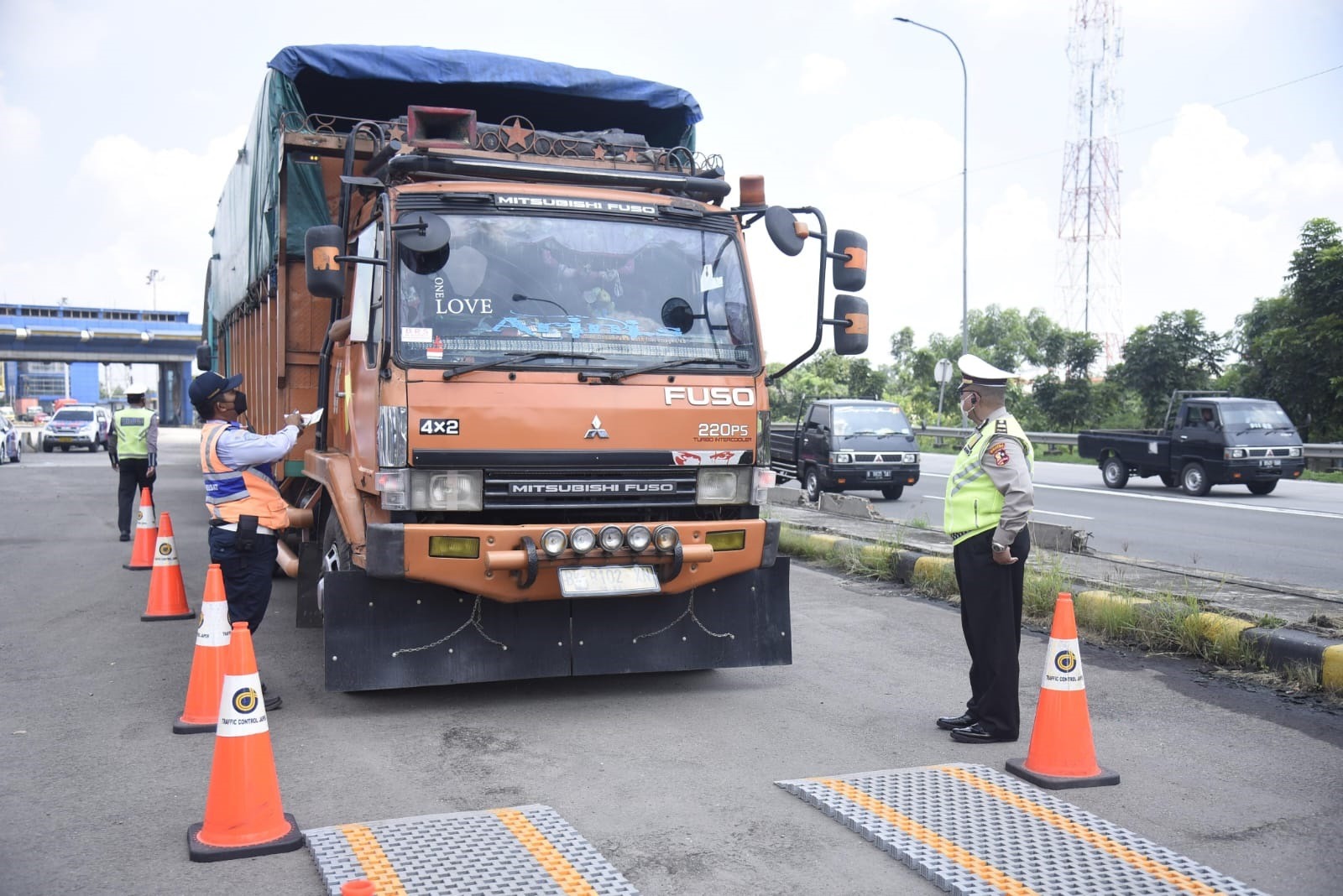
JAKARTA — The issue of Over Dimension Over Load (ODOL) vehicles remains one of the most critical challenges in establishing a safe and orderly traffic ecosystem in Indonesia.
The operation of freight transport vehicles that deliberately exceed standard dimensions or legally designated weight capacities does not merely violate established legal frameworks. This negligent behavior has been empirically proven to escalate the risk of fatal road accidents, jeopardizing the safety of countless road users.
For a long time, ODOL practices have been frequently observed across the logistics and commercial transportation sectors. In a bid to maximize cargo volume and transport a significantly larger amount of goods in a single trip, some operators illegally modify their fleets beyond factory specifications.
Certain business owners are also found forcing their transport fleets to carry cargo that far exceeds the maximum tonnage limits allowed by law. Mechanically, these extreme practices cause a drastic decline in vehicle performance and present immediate, multi-layered hazards on public lanes.
Framing the ODOL Crisis as a Public Safety Concern
Head of Korlantas Polri, Irjen Pol. Drs. Agus Suryonugroho, S.H., M.Hum., firmly asserted that the ODOL dilemma must not be viewed simply as a minor administrative or technical glitch within the freight transport industry. Instead, this issue must be addressed as a macro public safety concern that demands collective commitment and high-level structural oversight.
According to his operational analysis, every transport unit forced to hit the road with excessive dimensions and load limits carries an immediate catalyst to endanger human lives on highways and arterial roads alike.
“The ODOL issue must be fundamentally viewed as a critical public safety crisis that requires undivided collective attention,” stated Irjen Agus, issuing a firm warning to the sector.
This strong stance reinforces the government’s comprehensive commitment to realizing the national roadmap of a Zero ODOL Indonesia by the target year of 2027. This strategic national framework is not designed merely as a short-term punitive campaign or a conventional law enforcement crackdown, but rather as an integral part of a national doctrine to flatten the traffic accident curve and protect citizens.
Mechanical Breaches: Compromised Braking Systems and Rollover Hazards
One of the most obvious mechanical fallouts of operating an ODOL vehicle is the severe reduction in the driver’s ability to maintain total control over the moving fleet. Extreme cargo weight forces heavy-duty braking systems to work exponentially harder, causing significant brake fade and requiring a vastly longer stopping distance compared to standard safety margins.
In critical emergency situations along highways or narrow urban roads, these mechanical limitations render heavy trucks highly unmanageable. Consequently, this leads to a high probability of fatal multi-vehicle pileups and catastrophic collisions.
Furthermore, an uneven or disproportionate distribution of cargo weight completely disrupts the vehicle’s center of gravity. The risk of cargo trucks rolling over, losing balance during basic maneuvering at sharp turns, and triggering consecutive chain accidents spikes dramatically when a fleet is forced to shoulder burdens beyond its technical threshold.
The fatal consequences of these ODOL operations are not borne solely by the truck drivers or logistics workers themselves. Vulnerable road users—such as motorcyclists, private car drivers, public transport passengers, and pedestrians on walkways—frequently become the primary casualties when an overweight cargo truck experiences structural or mechanical failure.
Premature Destruction of State Infrastructure Assets
On another front, the prolonged survival of ODOL practices deals a direct, massive blow to the resilience of state-owned public infrastructure. Public roadways and highways that are continuously subjected to axle loads far exceeding their designed carrying capacities suffer from accelerated structural degradation and premature asphalt failure.
This continuous damage does not just compromise the lanes themselves; vital bridges and supporting transport facilities also face high risks of early structural fatigue. This widespread physical destruction ultimately forces the state to reallocate massive financial budgets for continuous roadway rehabilitation, draining funds that could otherwise drive economic expansion.
The legal boundaries regulating standard vehicle dimensions and freight operations are strictly codified under Law Number 22 of 2009 concerning Traffic and Road Transportation. This national law explicitly mandates that every transport unit deployed on public pathways must fully comply with technical requirements and possess a verified roadworthy status.
Therefore, commercial fleets are not only required to perform economically, but they also bear a strict legal obligation to unconditionally guarantee the safety of their drivers and the surrounding public.
Adhering to dimensions boundaries and cargo weight thresholds constitutes a binding core component of the legal and moral responsibility shared by fleet owners and logistics corporations. Intentionally overlooking these established boundaries means deliberately sidelining the element of safety, which must always remain the ultimate priority in a modern, civilized transport ecosystem.
To successfully achieve the landmark target of a Zero ODOL nation by 2027, active, multi-sector collaboration is highly critical. The government, law enforcement agencies, logistics sector players, corporate fleet owners, truck drivers, and general public elements must unite under the exact same frequency of safety-first compliance.
By nurturing a shared public awareness and maintaining high compliance with traffic laws, Indonesia is set to realize a transportation network that is safer, more efficient, equitable, and sustainable. Eradicating ODOL practices is ultimately about more than just checking regulatory boxes on paper; it is about honoring and protecting the right to life on every journey.