


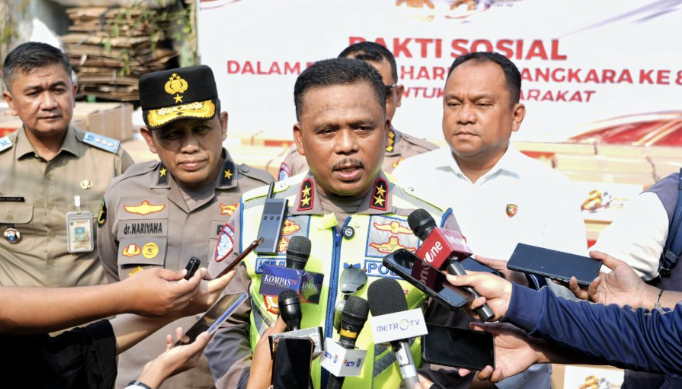
JAKARTA — The Indonesian National Police (Polri) has demonstrated a deep humanitarian commitment to the residents affected by the devastating fire in Kemayoran Gempol, Kebon Kosong, Kemayoran, Central Jakarta. This care is channeled through an integrated series of social initiatives welcoming the landmark 80th anniversary of Bhayangkara Day.
This emergency response goes far beyond the distribution of basic food logistics. The National Police has also established a free health clinic and provided a seamless process for reissuing vital administrative documents that were completely destroyed by the blaze.
Head of the Traffic Corps (Kakorlantas) of the National Police, Irjen Pol. Drs. Agus Suryonugroho, S.H., M.Hum., was present at the evacuation site, representing the Chief of the National Police, Jenderal Polisi Listyo Sigit Prabowo.
He symbolically handed over the social assistance while directly monitoring the operational flow to ensure that field interventions precisely matched the immediate needs of the evacuees.
“Representing the National Police Chief and the Bhayangkara Anniversary committee, we are handing over social aid to the affected community today, specifically those impacted by the fire,” stated Kakorlantas Polri directly among the displaced residents.
Logistics Distribution and Nationwide Social Frameworks
To help support daily survival needs, the National Police prepared approximately 500 logistics packages. These emergency boxes were systematically distributed to ensure that all affected residents received adequate support to fulfill their basic food needs during this challenging recovery phase.
Irjen Agus explained that this social aid distribution is an essential part of the 80th Bhayangkara Day theme, “National Police for Society.” Through these actions, the police force aims to position itself closer as a protective guardian for citizens enduring severe life hardships.
Beyond this immediate capital intervention, the National Police has finalized plans for similar humanitarian programs across various regions in Indonesia. These strategic programs will encompass home renovations, religious community services, agricultural equipment distribution, and clean water infrastructure projects.
Responsive Medical Interventions with Pusdokkes Polri
Shifting focus to physical well-being, Kakorlantas also inspected the ongoing free medical camp at the site. During this healthcare review, Irjen Agus was accompanied by the Secretary of the National Police Medical and Health Center (Sespusdokkes), Brigjen Pol. dr. Nariyana.
The medical deployment ensures that post-disaster healthcare services are rendered comprehensively and free of charge. This intervention is vital to safeguard the physical health of vulnerable evacuees, particularly toddlers and the elderly, within the temporary shelters.
“Today, we are present alongside Sespusdokkes. For healthcare services, we are conducting medical checkups for residents around the disaster-affected location,” Irjen Agus noted while reviewing the medical tents.
Dedicated Command Posts for Reissuing SIM, STNK, and BPKB
One of the most tactical steps addressing public anxiety is the police’s commitment to expediting the recovery of lost driving and vehicle ownership documents. Driver’s Licenses (SIM), Vehicle Registration Certificates (STNK), and Vehicle Ownership Books (BPKB) will be reissued through a specialized mobile service desk.
According to Irjen Agus, field personnel have been instructed to record residents’ grievances regarding damaged or missing credentials. Officers will execute swift data logging and initial verification so that the reissuance process moves rapidly without conventional bureaucratic hurdles.
“The command post is operational, and we hope to process these essential papers as quickly as possible to deliver top-tier service. This applies to SIM, STNK, BPKB, and other essential certificates,” the two-star general asserted firmly.
Based on temporary field data, the massive fire that hit the neighborhoods of RW 004 and RW 005 in Kebon Kosong destroyed hundreds of residential structures. Vulnerable demographics—such as senior citizens, infants, and school-aged children—remain the absolute priority in this humanitarian deployment.
By executing this three-dimensional service approach—combining food aid, medical assistance, and document recovery—the National Police proves that Bhayangkara Day is far from a mere ceremonial milestone. The 80th anniversary stands as a genuine avenue of service to solidify emotional alignment between the police force and the community.
Source: Korlantas Polri