


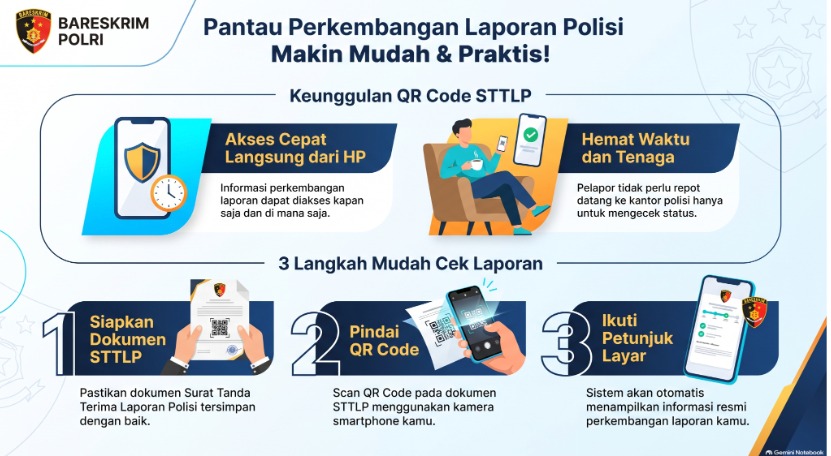
JAKARTA — For years, a brown folder containing copies of police reports was a loyal companion to complainants. The folder moved from desk to desk, was brought home, and was carried back to the police station every time a complainant wanted to know the fate of their case. Today, a single QR code on the Police Report Receipt (STTLP) is beginning to change that habit.
Scanning that QR code serves as an entry point to digital information regarding case progress. By scanning it, complainants are directed to the Progress Report on Investigation Results (SP2HP) without having to visit the investigators’ room in person.
A Long-Standing Issue Experienced by Many Complainants
The main issue for complainants is often not the legal process itself, but the lack of information. Many complainants do not know what stage their case has reached. As a result, they commute back and forth to the police station or repeatedly call officers just to ask for updates.
This situation is exhausting for complainants. On the other hand, investigators lose working time answering the same questions. Such a dark space of information easily breeds suspicion, as if the report is not being handled, even though the investigation is actively ongoing.
QR Code as an Information Bridge
This is where the scan QR code STTLP comes into play. A document that originally served merely as proof of report receipt now also functions as access to information regarding case progress.
SP2HP itself is not new. This document is a complainant’s right to know the progress of their case handling. Pusiknas Bareskrim Polri highlights SP2HP as a means to guarantee accountability and transparency, while providing space for the public to evaluate police performance.
The difference lies in the method of access. Information that previously had to be fetched physically can now be opened via a smartphone screen. Bareskrim Polri also provides an SP2HP Online service managed by Pusiknas Bareskrim Polri as an official channel for tracking case progress.


Measurable Transparency
This change shifts the relationship between complainants and investigators. Complainants no longer merely wait for news; they can monitor progress independently. Investigators are also encouraged to update information consistently because every stage can be viewed by the interested parties.
This type of transparency is measurable. SP2HP details the main substance of the case, investigative actions already taken along with their results, obstacles encountered, and planned next steps. This information provides a clear picture rather than a vague promise.
In the end, the brown folder may not disappear entirely just yet. However, the presence of the scan QR code STTLP shows that investigative services are moving toward greater openness. Criminal investigation services are now progressing toward transparency, where every report is not only received but can also be tracked by the complainant from anywhere.