


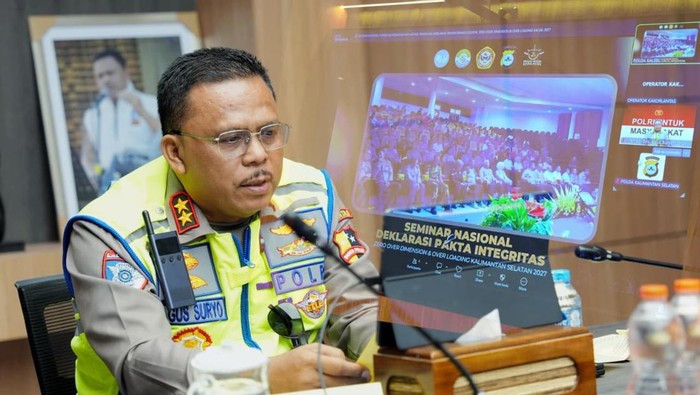
JAKARTA — Head of the Traffic Corps (Kakorlantas) of the Indonesian National Police, Irjen Pol. Drs. Agus Suryonugroho, S.H., M.Hum., emphasized the critical importance of regulatory synergy and consistent law enforcement in establishing a safe and sustainable transportation network.
He requested full support from all relevant stakeholders to actively participate in realizing the national Zero Over Dimension and Over Loading (ODOL) framework by 2027 to uphold public safety margins.
This statement was conveyed directly by Irjen Agus while serving as the keynote speaker via a virtual Zoom network during the National Seminar and Integrity Pact Declaration held in Banjarmasin, Wednesday (June 17, 2026).
The major event carried the strategic theme “Regulatory Synergy and Law Enforcement Toward a Zero Over Dimension & Over Loading South Kalimantan.”
During the interactive session, Irjen Agus expressed deep appreciation and high praise to the academic community of Lambung Mangkurat University (ULM) and the regional South Kalimantan Police. Both regional institutions are recognized as pioneers that moved swiftly to respond to the national strategic program regarding overloaded truck control.
“I am highly pleased and express extraordinary appreciation to Lambung Mangkurat University and the South Kalimantan Regional Police, who were the first to organize such an amazing seminar right after the central government established the roadmap toward Zero Over Dimension and Over Loading,” stated the Kakorlantas Polri warmly.
Dissecting the Legal Difference Between Traffic Crime and Infraction
According to Irjen Agus’ legal analysis, the chronic issue of excessive dimension and overload within freight transport must no longer be viewed narrowly as a minor technical hitch or a mere traffic sign infraction. This deep-rooted problem must be analyzed from hulu to hilir (end-to-end) because it directly impacts human safety variables, economic stability, and national transportation governance.
Furthermore, the Kakorlantas deeply explained that there is a fundamental legal distinction between over-dimension and over-loading cases. He asserted with absolute clarity that illegally altering a vehicle’s structural size (over-dimension) constitutes a traffic crime.
On the other hand, forcing a fleet to carry cargo beyond its technical kelaikan threshold (over-loading) is categorized as a traffic infraction. Due to these distinct juridical characteristics, tactical field enforcement executed by traffic officers must be precise, analytical, and well-measured.
The central government, alongside technical ministries and relevant institutional bodies, including the Korlantas Polri, is currently finalizing the blueprint documents. This working blueprint is structured to guide the full implementation of the Zero ODOL program, which is targeted to run simultaneously nationwide starting January 1, 2027.
A Holistic Approach Spanning Fiscal to Sociological Facets
“When we talk about over-dimension and over-loading, it is deeply holistic. We must review it from multiple facets—economic, fiscal, sociological, and psychological—not just restricted to the realm of law enforcement,” the two-star general elaborated on his analytical framework.
Irjen Agus added that the coordinated steps toward a Zero ODOL Indonesia will be executed progressively through three layers of institutional intervention: pre-emptive, preventive, and firm law enforcement. This operational format will consistently move forward while carefully considering local community conditions and the stability of the industrial logistics sector.
He also reminded all seminar participants and transportation entrepreneurs in South Kalimantan that the ultimate purpose of this regulatory restriction is purely to safeguard public road spaces and honor the right to life for all commuters.
“Public roads are shared living spaces. No short-term economic gain is more valuable or precious than human safety,” Irjen Agus concluded, ending his scientific oration on a wise and optimistic note.