


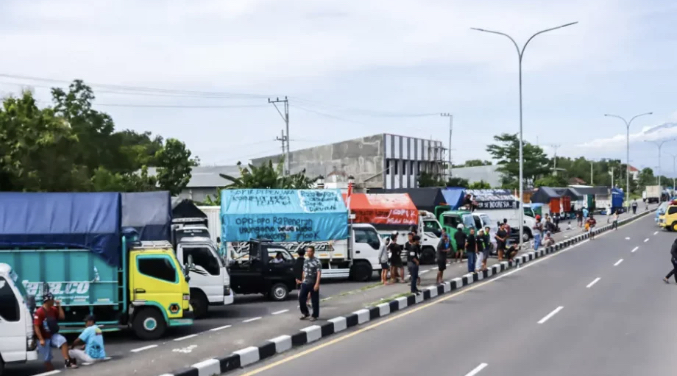
JAKARTA — Efforts to transform behavioral patterns on public roads will never be truly effective if they rely solely on rigid, strictly punitive law enforcement actions.
Within the comprehensive roadmap of the Zero Over Dimension Over Load (ODOL) 2027 agenda, massive public outreach and strategic education must be placed as the definitive gateway before legal sanctions are fully executed. The fundamental challenge of ODOL practices is not limited to commercial vehicles breaching standard size boundaries and cargo volume thresholds.
This deep-rooted structural issue is closely tied to decades-old, obsolete habits within the national logistics industry that have unfortunately been normalized by certain business circles for far too long.
The Traffic Corps of the Indonesian National Police (Korlantas Polri) consistently positions humanistic and persuasive approaches as vital components in managing ODOL infractions nationwide. All stakeholders—including business entities, truck drivers, fleet owners, logistics operators, and the general public—need to clearly understand that operating vehicles with excessive dimensions and weight systematically threatens lives.
“We want to foster a collective awareness that road safety is a shared responsibility,” states a core institutional message, which serves as the strategic foundation for this humanistic engagement model.
Education as the Anchor for Sustainable Transportation Culture
The underlying principle remains that safety awareness born out of a genuine understanding will endure far longer within public conscience than artificial compliance driven strictly by a fear of police fines. Therefore, traffic safety education should never be dismissed as a soft or ineffective enforcement measure.
It is precisely through consistent, well-targeted educational frameworks that the roots of national transportation culture can grow stronger, more resilient, and sustainable.
Widespread socialization is critical because not all transportation players completely grasp the dangerous domino effect caused by ODOL practices. Many operators still view overloading cargo as an instant shortcut to compress corporate operational expenses.
Yet, behind those temporary commercial gains lies an immediate risk of fatal road accidents, accelerated destruction of state-owned road infrastructure, and a direct threat to the stability of public safety.
Moral Collaboration Across All Road User Groups
By strengthening educational pipelines, Korlantas Polri can transparently explain that every commercial vehicle is strictly mandated to comply with standard dimensions limits and maximum weight capacities fixed by manufacturers and the state. This vital safety message must be communicated continuously using simple language that easily resonates with field drivers and corporate fleet owners.
The goal is not merely to force compliance under the shadow of written regulations, but to actively stimulate public awareness regarding why maintaining road discipline is essential for humanity.
ODOL violations are not a private matter or an internal issue restricted to freight drivers and freight forwarding firms. When heavily overloaded vehicles are forced onto public lanes, all other road user groups automatically inherit the fatal risks in the field.
Motorcyclists, private vehicle drivers, public transport passengers, and pedestrians on walkways can instantly become casualties if an overweight cargo truck experiences a sudden braking failure or loses its balance.
Consequently, traffic safety must be declared a collective responsibility. While the state holds full authority to enforce positive legal frameworks, commercial enterprises and civil society bear a profound moral obligation to avoid creating structural hazards in public spaces.
At this turning point, managing ODOL infractions can transform into a comprehensive social movement, transcending the boundaries of routine roadside crackdowns by traffic police units.
Law Enforcement Remains Robust Under State Regulations
A humanistic, educational focus does not mean dissolving strict law enforcement on public roads. Law Number 22 of 2009 concerning Traffic and Road Transportation stands firm as the primary legal foundation to ensure that every vehicle complies with technical specifications and roadworthiness requirements.
Punitive actions and on-the-spot ticketing remain highly necessary against visible infractions that actively put the lives of the general public at risk. However, an effective and well-respected law enforcement framework must always be preceded by providing sufficient information to the public.
When communities and business owners are equipped with accurate information, healthy channels for dialogue, and a fair window to correct their driving behaviors, traffic police enforcement gains significantly stronger social legitimacy and public respect. Law is thus present in society not as a frightening instrument of intimidation, but as a protector of human life.
Progressing toward the landmark target of a Zero ODOL nation by 2027 demands a realistic, mature, and structured implementation process. Educational programs, continuous outreach, digitalization of highway and arterial surveillance networks, and cross-sector ministerial collaborations must advance in perfect harmony.
If all stakeholders align to move at the exact same frequency of safety awareness, the national transportation landscape is guaranteed to develop into an ecosystem that is safer, more orderly, efficient, and civilized.
Ultimately, building independent awareness carries far greater value than chasing high statistical data on police tickets in performance logs. Safe and comfortable public roads are uniquely born from a society that genuinely understands operational hazards and willingly chooses to act responsibly, because road safety is far more than an administrative legal obligation—it is a sacred, collective commitment to preserve human life.
News Sources: Mediahub Polri, Instagram Korlantas Polri, Peraturan BPK UU Nomor 22 Tahun 2009, Dishub Kota Malang UU Nomor 22 Tahun 2009, Kompas Otomotif